How Close Can A Kayak Get To Whales And Dolphins In Byron Bay?
The official NSW approach distances for kayaks near whales and dolphins in Byron Bay, plus what the local tour operators say about sightings and watching from the kayak.
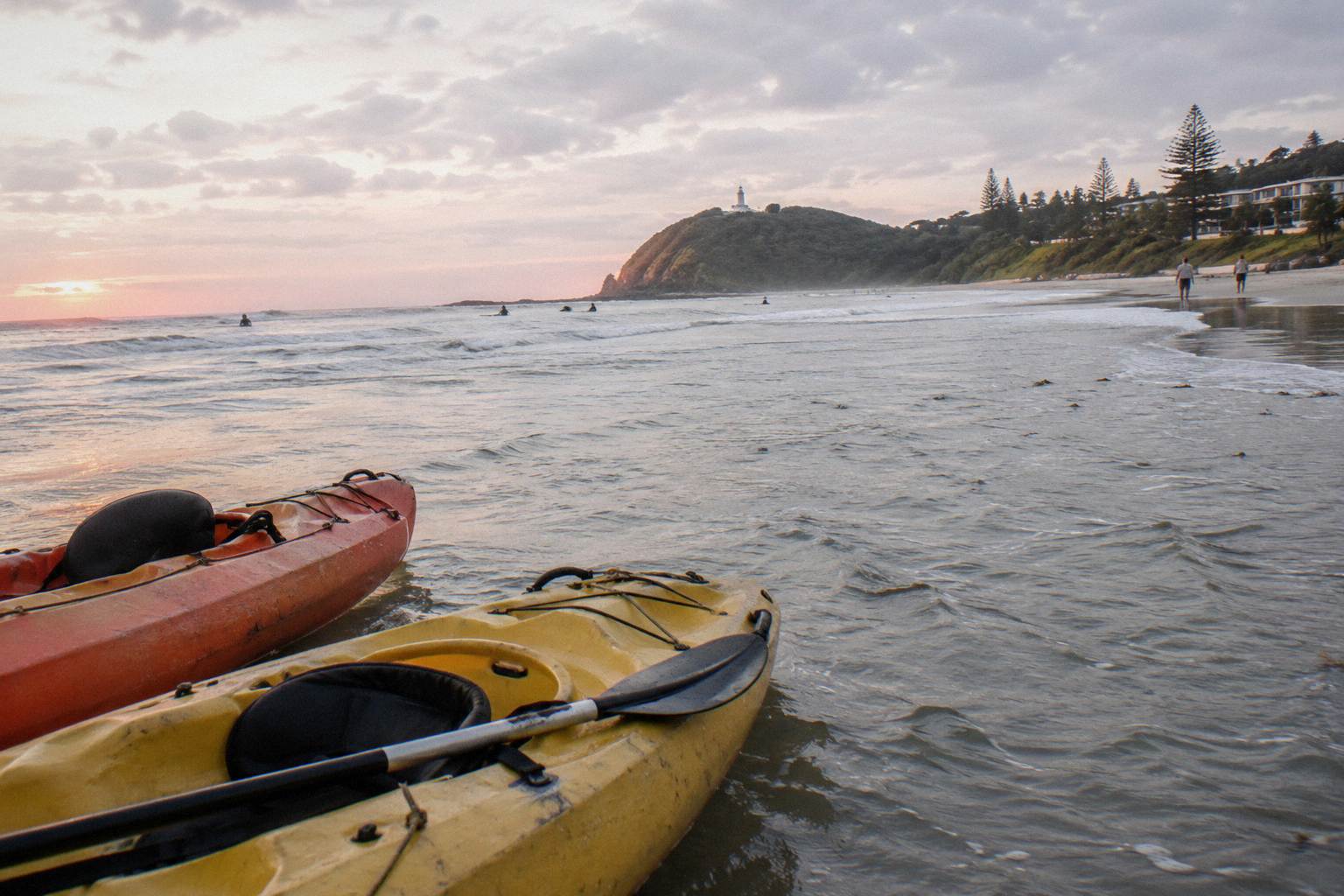
A kayak may come no closer than 50 metres to a dolphin and 100 metres to a whale, because NSW law counts a kayak as a vessel. Larger caution zones apply at 150 metres for dolphins and 300 metres for whales, with extra behaviour rules inside them: no approaching from behind, a side approach of at least 30 degrees to the animal's direction of travel, constant slow speed, and no entering the caution zone at all if a calf is present. NSW Environment and Heritage states these distances, and they bind every paddler in Byron Bay, guided or not.
The numbers surprise people. Fifty metres sounds generous until you picture it: roughly half a football field of ocean between your bow and the nearest dolphin. On a guided tour the guide manages that gap, because a licensed commercial operator breaking approach rules risks its permit, and both Byron Bay ocean kayak operators hold licences from the Cape Byron Conservation Area Trust, Byron Shire Council and NSW Maritime, as Cape Byron Kayaks states on its site.
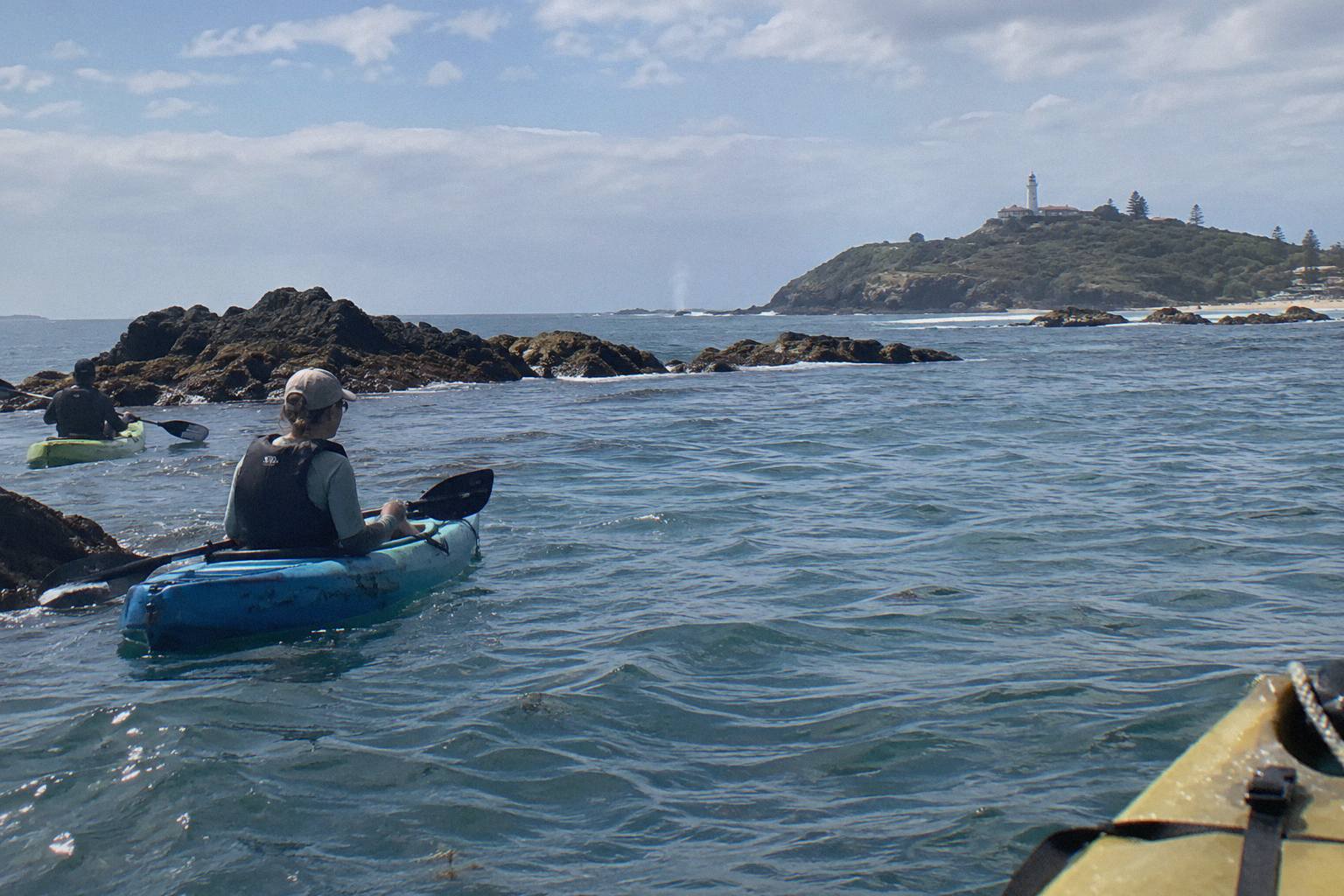
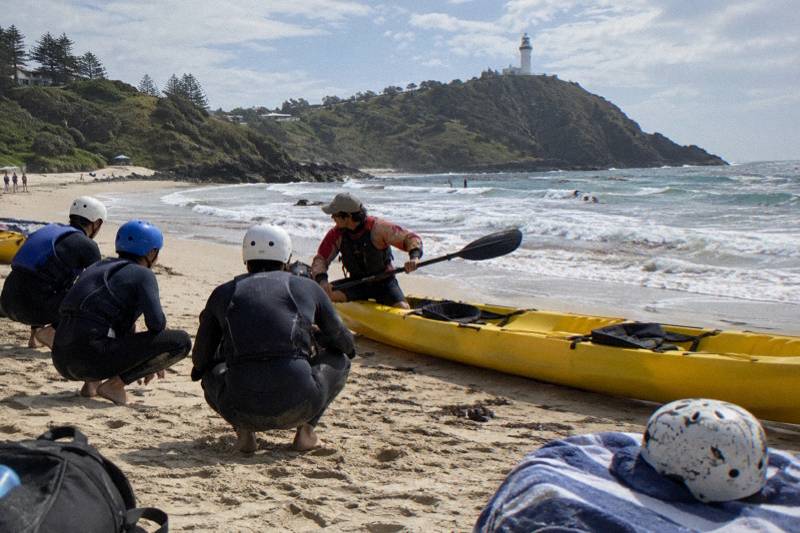
That is the practical answer for anyone weighing a booking. The tours do not chase animals to the legal line; they hold a respectful distance while dolphins, and in season whales, move through their own range. Cape Byron Kayaks describes its route as leaving from Clarkes Beach and following the coastline out to the Cape, catching up with its dolphin friends at Wategos Beach, which is operator wording for the same idea: the paddlers travel to where the animals already are.
Two ocean tours in town work within these rules, and a calm flat-water alternative exists for anyone who would rather not deal with the open sea at all.
Why A Kayak Is Treated Like Any Other Vessel
NSW approach rules define a vessel broadly enough to name kayaks directly, so a plastic double sit-on-top carries exactly the same legal obligations on the water as a motorboat. No exception is made for paddle power, hull size, or the lack of an engine; once the rules bind a motorboat, they bind the kayak beside it in identical measure. There is no small-craft exemption, no allowance for being quiet, and no allowance for moving under paddle power alone, so a kayaker who closes on a dolphin below 50 metres breaches the rule just as a skipper would. The NSW Environment and Heritage page sets one framework for all vessels and then layers behaviour requirements on top of the raw distances.
The reasoning sits with the regulator, not with guesses about dolphin comfort. Inside a caution zone, 150 metres for dolphins and dugongs and 300 metres for whales, a vessel must never approach an animal from behind, must not wait in front of it, and must approach from the side at an angle of at least 30 degrees to its direction of travel. Speed must stay constant and slow with negligible wake, and if two or more people are on board, one must act as a lookout.
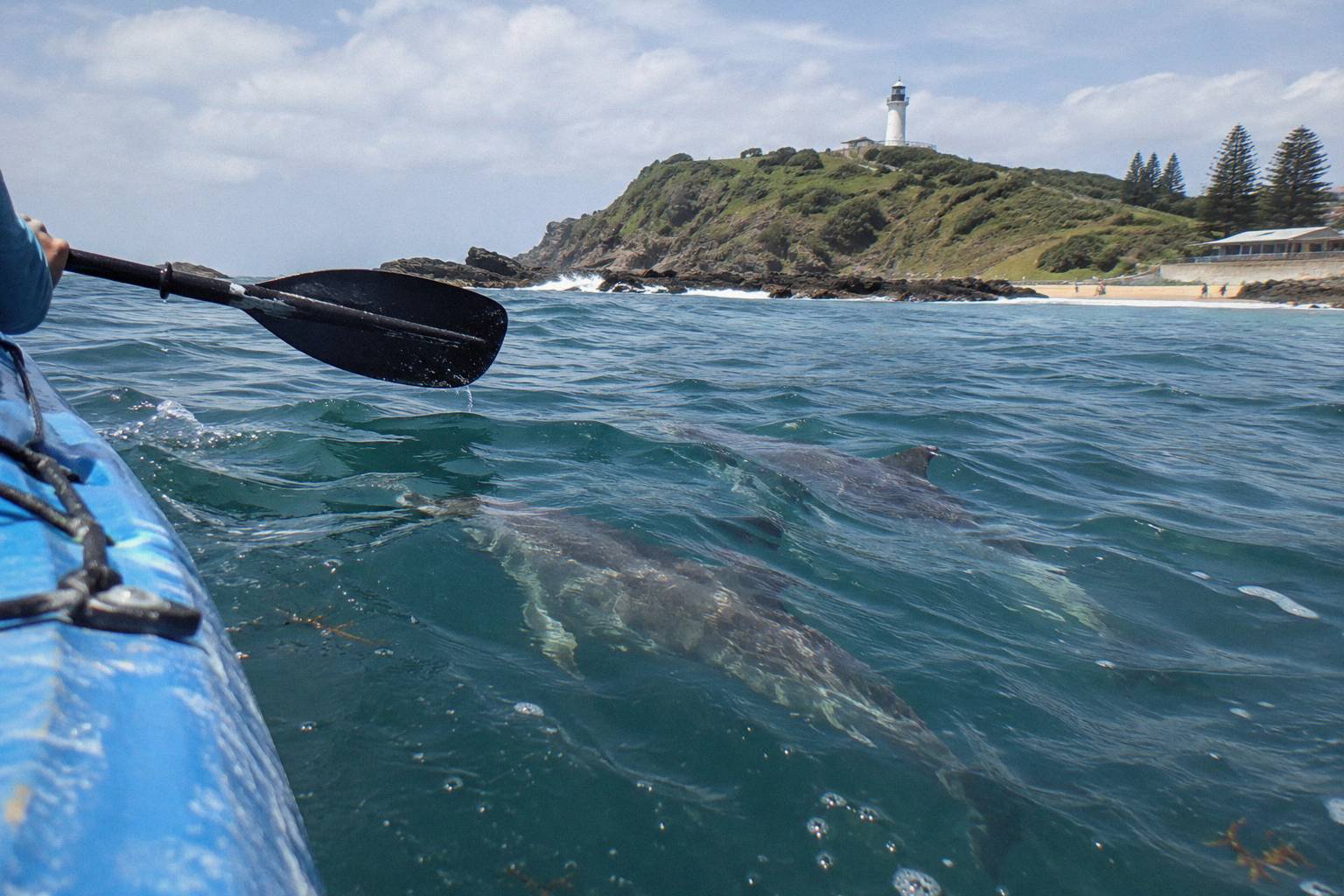
Two further conditions catch paddlers out. Only three vessels may be inside the entire caution zone at once, so on a busy morning the guide may hold the group back even at a legal distance. And if a calf is present, no vessel may enter the caution zone for closer viewing at all, which in whale season can push a tour well outside the 300 metre line. One more quirk works in the animals' favour: if dolphins begin bow-riding, the vessel must keep its course and speed rather than slowing or turning, so the animals control that encounter, not the paddlers.
For whales the page adds a self-directed instruction: if a whale approaches the vessel, slow to minimal wash speed and avoid sudden movements. A kayak cannot outpace a humpback anyway, and the rule recognises that the animal sometimes closes the distance itself, which is legal in a way that paddling toward it is not. A mostly white whale, dolphin or dugong gets a 500 metre buffer under the same page, a rare condition but one worth knowing before assuming the rules have a single number for every animal.
| Situation | Minimum distance | Applies to | Source |
|---|---|---|---|
| Vessel near a dolphin or dugong | 50 m | Kayaks, boats, surf skis, surfboards | NSW Environment and Heritage |
| Vessel near a whale | 100 m | Kayaks, boats, surf skis, surfboards | NSW Environment and Heritage |
| Caution zone, dolphin or dugong | 150 m | All vessels, 3 vessels maximum inside | NSW Environment and Heritage |
| Caution zone, whale | 300 m | All vessels, 3 vessels maximum inside | NSW Environment and Heritage |
| Calf present | No caution-zone entry | All vessels | NSW Environment and Heritage |
| Mostly white animal | 500 m | All vessels and swimmers | NSW Environment and Heritage |
| Swimmer near a dolphin | 30 m once in the water | Swimmers, snorkellers, divers | NSW Environment and Heritage |
| Drone over a marine mammal | 100 m | Unmanned aerial vehicles | NSW Environment and Heritage |
The drone line matters more than it looks. Tour photographers and travellers both fly cameras over wildlife, and 100 metres is the ceiling the page sets. Cape Byron Kayaks posts its own tour photos online for guests, which removes most of the temptation to launch a drone of your own from a double kayak, something that would end badly regardless of the law.
If the distance rules have settled the question and the remaining decision is which paddle to book, the guided dolphin kayak run from Clarkes Beach is the trip built around them.
Watching From The Kayak, Not The Water
The same official page lets swimmers enter no closer than 50 metres to a dolphin and 100 metres to a whale, but requires at least 30 metres of separation once in the water, and no Byron Bay kayak tour offers swimming with dolphins at all. Cape Byron Kayaks is blunt in its own words: there are strict rules about approaching wild animals in NSW, and the paddlers observe the dolphins from the kayaks. That is not a marketing choice dressed up as law, it is the operator describing how the encounter actually works on the water.
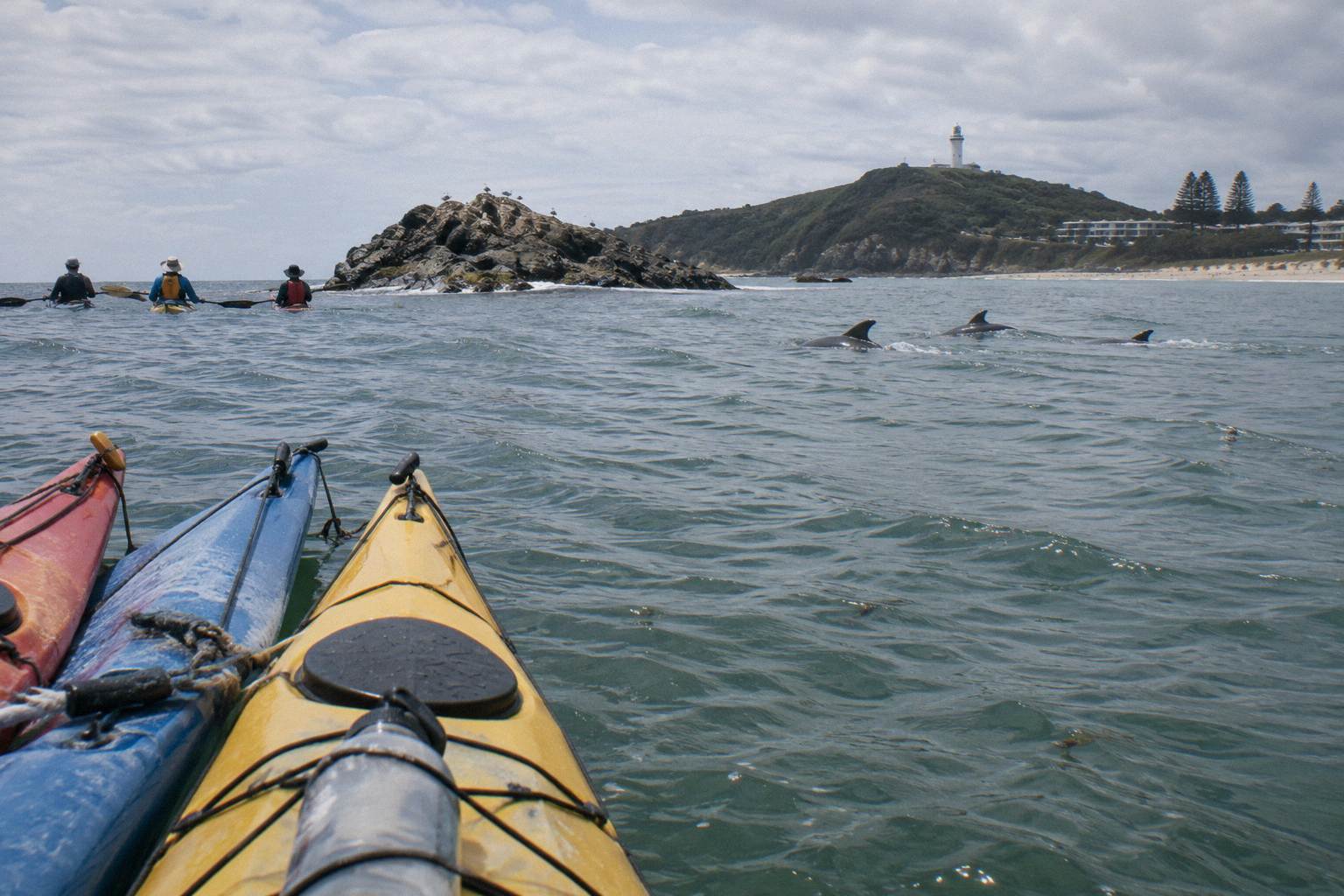
Anyone hoping to slip over the side should reset expectations before booking. None of the six tours covered on Byron Bay Dolphin Kayak includes swimming with dolphins, and the swim-distances rule exists for exactly that scenario: a person in the water must keep 30 metres from any whale, dolphin or dugong, calf included. The question of whether getting in the water with wild dolphins is possible in Byron Bay at all has its own full answer in whether swimming with dolphins is allowed, and the short version is that the tours do not do it.
The observation-from-the-kayak format still delivers the encounter most people are chasing. Dolphins routinely approach vessels on their own terms, and the bow-riding rule, keep course and speed, exists precisely because they do. A pod choosing to travel alongside a slow-moving double kayak can pass far closer than 50 metres without anyone breaking the law, since the animals initiated it. The guide's job is to hold a steady line and let that happen, which is why both operators describe their trips as guided group tours rather than hire.
That distinction matters for independent paddlers too. Neither Byron Bay ocean operator rents kayaks, and Go Sea states the local coastline is not suitable for rental kayaks, so the practical way to be on the water near dolphins here is on a guided trip where someone who knows the rules is managing the distance. A traveller deciding between a paddle and other formats can compare kayak tours against boat cruises for dolphins before committing.
What The Operators Promise, And What They Carefully Do Not
Neither Byron Bay operator promises a sighting on the day, and both publish sighting language that stops well short of a guarantee. That gap is deliberate. What you are sold is the possibility of whales; what you are never sold, in writing, is the whales themselves. The operators promise the trip, and carefully decline to promise what swims past it. Cape Byron Kayaks says it sees dolphins on over 90% of its kayak tours and describes a pod of around 300 resident dolphins on its FAQ, then answers a plain "No" to its own question "Do you always see dolphins?". Go Sea says that on most tours it spots dolphins, and from June to November it often spots whales. Those are operator statements about their own records, and the honest way to read them is as a strong track record with an acknowledged gap.
What each operator does promise is a make-good. Both run a free return tour, never a refund, if the wildlife does not appear: Cape Byron Kayaks issues a non-expiring, non-transferable return tour, and Go Sea's version, the Go Sea Guarantee, invites paddlers back for free if no dolphin, turtle or whale is seen. The return tour is the standard remedy across both, and it is worth knowing that Cape Byron Kayaks requires the same 24 hour cancellation notice on those return bookings. The fuller mechanics sit in what happens when no dolphins appear.
Sighting percentages belong to their authors. The 90% figure is Cape Byron Kayaks' own, from its home page and FAQ, and the roughly 300 strong resident pod is its wording as well. Go Sea's booking page title names dolphins and turtles, and the National Parks and Wildlife Service page for its tour lists playful dolphins, sea turtles and, during migration season, humpback whales as local wildlife. A public agency naming the animals is the strongest neutral signal available, and even it does not promise an encounter on a given morning.
| Operator claim | Exact wording source | What it means for a booking |
|---|---|---|
| Cape Byron Kayaks: dolphins on over 90% of tours | Home page and FAQ | Strong record, but the FAQ also answers "No" to always seeing them |
| Cape Byron Kayaks: pod of around 300 resident dolphins | FAQ | Operator description of the local pod |
| Go Sea: "on most tours we spot dolphins" | FAQ | No percentage given by the operator |
| Go Sea Guarantee: free return if no dolphin, turtle or whale | FAQ | A return tour, never a refund |
| Cape Byron Kayaks guarantee: free, non-expiring return tour | FAQ | Rebooking by phone with a card hold |
| NPWS: dolphins, turtles and humpbacks named as local wildlife | National Parks tour page | Neutral confirmation the animals are present, not a promise |
Ratings tell a similar story of consistency without perfection. The Cape Byron Kayaks dolphin tour holds 4.4 across 402 reviews on its booking page, and the Go Sea ocean tour, from AUD 59 per person with the price varying by date, is rated 4.6 on its booking page. Those are healthy scores from real pools, and the reviews behind them include trips where the dolphins stayed away, which is exactly what a 90% rate implies the other 10% of the time. Whale season adds another layer, and the operators' stated months differ, so treat the whale watching season breakdown as the reference rather than any single month.
The Go Sea ocean trip is the one with the printed price, and it is the natural comparison point for anyone booking on numbers rather than reviews.
Extra Rules Inside Cape Byron Marine Park
The approach distances are state law, and on top of them the marine park's zoning plan adds its own restrictions, including a ban on fishing and collecting in sanctuary zones and a prohibition on feeding fish anywhere in the park. Sanctuary zones cover 6,118 hectares, or 27.5% of the park, and habitat protection zones a further 4,271 hectares, 19.2%. Sanctuary zones are no-take, while activities that do not harm animals, plants or habitat remain permitted, according to the DPIRD marine park pages.
For a kayaker on a guided tour, almost none of this requires thought. The guide holds the commercial permit, the group stays together, and the two activities a visitor might innocently contemplate, feeding fish to attract them and dropping a line in a sanctuary zone, are both prohibited. The zoning plan's user guide also restates that the NSW approach rules apply inside the park and that commercial operators need a marine parks permit. East Cape Byron sits in a habitat protection zone, and the foreshore beaches and estuaries outside sanctuary zones fall into habitat protection or special purpose zones.
One commercial restriction in the user guide shapes the whale side of the local scene: no permits are granted for commercial vessels to undertake whale watching in the marine park east of Cape Byron or within 1 km of the Cape Byron Lighthouse. That pushes powered whale watching boats away from the cape itself, which is part of why the kayak tours, operating under their own licences, have the near-shore line largely to themselves. The full picture of paddling inside park boundaries is in the Cape Byron Marine Park kayak guide.
Common Mistakes When Planning Around The Distance Rules
The most common mistakes are expecting a tour to run right at the legal minimum, treating the 90% sighting figure as a guarantee of a sighting, and arriving without knowing which operator's swim and age rules actually fit the group; each assumption can quietly undercut a trip planned around the distance rules. A guided paddle holds distances the guide judges safe and lawful, which is often well outside 50 metres, and the sighting rate is Cape Byron Kayaks' own statistic with a built-in other 10%. Swim rules genuinely differ between the two operators, so the choice of tour matters as much as the choice of day. Booking the wrong one for a nervous swimmer is the most common mismatch of all.
Cape Byron Kayaks takes no non-swimmers and requires paddlers 16 and over to swim 25 metres unassisted, while Go Sea accepts non-swimmers who tell the guide and wear a life jacket. Minimum ages sit at 5 on both ocean tours, with Cape Byron Kayaks asking that under 16s be accompanied one adult to one child, and the Brunswick River tours taking children from age 3. None of this is interchangeable between operators, and each figure comes from the operator's own FAQ.
A few smaller missteps cost people the day outright. Turning up at the wrong shed happens, because the two operators check in at different points on Lawson Street, Cape Byron Kayaks at Shed 2 opposite 60/62 Lawson Street with a 15 minute early check-in, and Go Sea opposite 58 Lawson Street at Shed 1, asking for arrival 20 minutes before departure. Expecting a refund when dolphins stay away is another, since both operators offer a return trip instead. And packing for a dry outing is a mistake Go Sea pre-empts in its own FAQ: asked whether paddlers get wet, its answer is a one word yes.
Bringing a drone in the hope of close whale footage collides with the 100 metre aerial limit. Feeding fish or casting a line in a sanctuary zone collides with the zoning plan. Neither is a gray area, and both are easier to avoid by leaving the gear at home and letting the operator, which posts its own photos after the trip, handle the imagery. Anyone uncertain about gear can settle it in advance with what to wear and bring on the water.
For travellers who would rather skip the open-ocean distances entirely, the flat-water alternative keeps the wildlife and drops the swell. The stand up paddle nature tour on the Brunswick River, rated 5.0 across 391 reviews on its booking page, runs about 2 hours from Brunswick Heads, with the meeting address given after booking.
The guided dolphin kayak tour from Clarkes Beach remains the trip most directly shaped by the rules in this article, and the Cape Byron Kayaks dolphin paddle is the booking that puts a licensed operator between you and the 50 metre line. Check availability if the dates line up, keeping in mind that unsafe wind or large swell cancels ocean tours and that the return-tour guarantee needs 24 hours of notice to rebook.
Whichever format fits, the through-line is simple: the law fixes the distances, the animals decide the encounters, and a good tour operator is the one who respects both.
Common Questions About Kayaking Near Whales And Dolphins In Byron Bay
How Close Can A Kayak Get To Whales And Dolphins In Byron Bay?
No closer than 50 metres to a dolphin and 100 metres to a whale, with caution zones of 150 metres and 300 metres respectively, because NSW law counts a kayak as a vessel. The rules come from NSW Environment and Heritage and apply to every paddler on the water.
Can A Dolphin Come Closer To The Kayak Than 50 Metres?
Yes, if the animal approaches on its own. The rules restrict vessel behaviour, and where dolphins begin bow-riding, the instruction is to keep course and speed rather than turning away. The closest legal encounters are the ones the dolphins initiate.
Do The Rules Change When A Calf Is Present?
Yes. When a calf is present, no vessel may enter the caution zone for closer viewing at all, which can push kayaks well outside the usual 150 metre dolphin or 300 metre whale line. Guides manage this on the water.
Can You Swim With Dolphins From A Byron Bay Kayak Tour?
No. No tour in Byron Bay offers swimming with dolphins, and Cape Byron Kayaks says in its own words that paddlers observe the dolphins from the kayaks under strict NSW rules. Swimmers in the water must keep at least 30 metres from any whale, dolphin or dugong.
What Happens If The Kayak Tour Sees No Dolphins?
Both ocean operators offer a free return tour, never a refund. Cape Byron Kayaks issues a non-expiring return tour and reports seeing dolphins on about 90% of its tours, while Go Sea invites paddlers back for free if no dolphin, turtle or whale appears.
Do The Approach Rules Differ For Kayaks And Boats?
No. The NSW vessel definition names non-motorised boats, surfboards, surf skis and kayaks, so the same distances and caution-zone behaviour rules apply to a double kayak and a motorboat alike. Separate marine park rules add zoning restrictions on top.